
Why the Physics Engine is the Unsung Hero of Modern Zelda and Must Stay
The stellar physics engine in *The Legend of Zelda: Tears of the Kingdom* is the non-negotiable bedrock for future games, powering immersive, creative, and emergent gameplay that transforms Hyrule into an interactive playground.
While the buzz around The Legend of Zelda: Tears of the Kingdom often centers on the game-changing Ultrahand ability, there's a deeper, more fundamental system that deserves the spotlight: its physics engine. As of 2026, with the next Zelda adventure on the horizon, discussions are swirling about what should stay and what should go. While Ultrahand is likely a one-time marvel, a sentiment echoed by Nintendo's hints at a new direction, one element from the Breath of the Wild and Tears of the Kingdom era is non-negotiable for the future: the stellar, immersive physics system that powers the heart of the experience.
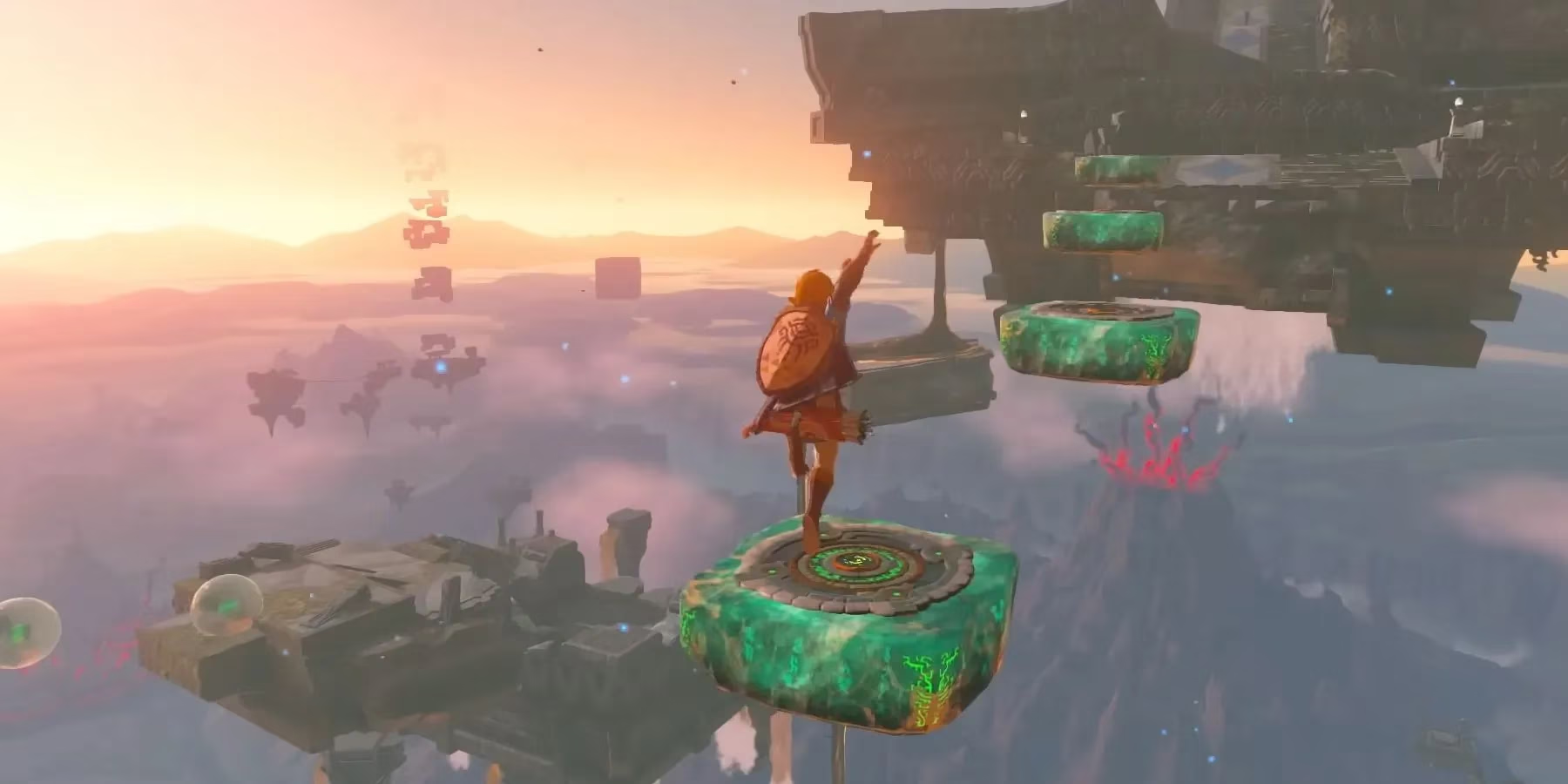
Let's be real. The shift from traditional Zelda to the open-world formula of Breath of the Wild was monumental. A huge part of what made that world feel alive and responsive wasn't just its size—it was the consistent, predictable, yet wonderfully chaotic rules governing every object within it. This physics foundation isn't just a background feature; it's the bedrock upon which puzzles are built, combat becomes creative, and exploration turns into pure joy. 🎮✨
Think about it. In Breath of the Wild, players weren't just solving puzzles; they were engineering solutions.
-
Using Stasis on a boulder, whacking it repeatedly, and watching it launch an enemy into the stratosphere.
-
Creating makeshift catapults with metal plates and Magnesis.
-
Freezing an enemy on a cliff's edge with an ice arrow and giving them a gentle (or not-so-gentle) nudge.
All of these iconic, shareable moments were born from a physics system that players could intuitively understand and then completely break in the most entertaining ways possible. It transformed Hyrule from a beautiful landscape into a giant, interactive playground.
Tears of the Kingdom didn't replace this engine; it supercharged it. 💥 Ultrahand's building mechanics were a revelation precisely because they plugged directly into that existing, reliable physics framework. The weight, balance, and momentum of every Zonai device and wooden plank felt real. This synergy is what made those wild vehicle creations and Rube Goldberg machines possible. It gave players a nearly infinite sandbox for creative problem-solving, proving the engine's versatility.
So, why is this so crucial for the next game? Simple: it's the ultimate tool for emergent gameplay. A physics system this good doesn't dictate how to play; it invites experimentation. With a new Hyrule, new abilities, and a fresh art style (as suggested for the 2026+ title), this same engine could unlock entirely new forms of play we haven't even imagined yet.
Imagine a Zelda that leans even further into immersive sim elements, where weight, friction, and material properties are central to puzzle design. The foundation is already there! Ditching this system would be like building a new house on sand after you've already perfected the concrete.
Here’s what the future needs to keep:
✅ A Consistent, Expressive Physics Core: The "rules" of the world must feel tangible and reliable.
✅ Support for Emergent Creativity: The engine should enable, not restrict, player ingenuity.
✅ Synergy with New Abilities: Whatever new powers Link gets should interact with the physical world in meaningful, surprising ways.
Ultimately, while features like weapon durability might be divisive and Ultrahand may be a glorious one-hit wonder, the physics engine is the silent workhorse. It makes the world believable, the puzzles satisfying, and the gameplay infinitely replayable. The next Zelda has big shoes to fill, and its best step forward is to stand firmly on the robust, brilliant foundation laid by its immediate predecessors. The soul of modern Zelda's magic isn't in a single ability—it's in the very laws of its universe. 🌌