
Unveiling the Bargainer Statues' Enigma
Bargainer Statues in Tears of the Kingdom’s Depths trade Poes for dark armor, fueling theories of them as psychopomps guiding lost souls.
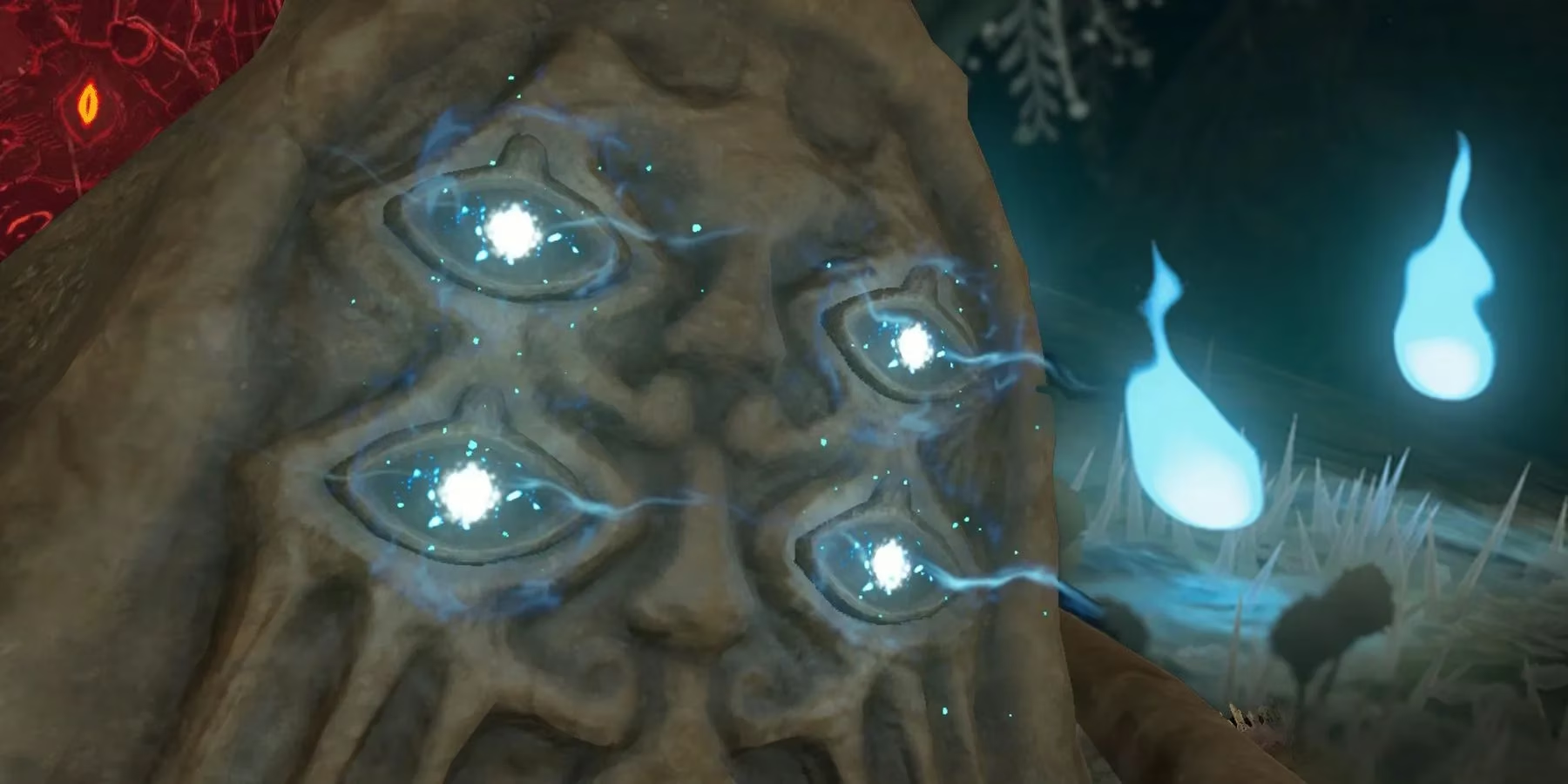
I still remember the first time I dropped into the Depths. The moment you dive through a chasm, the light of Hyrule vanishes, replaced by an oppressive darkness broken only by faint, flickering glow of Poes and the occasional Lightroot. It was during one of those early, nerve-wracking excursions that I stumbled upon something truly strange: a massive, cyclopean face carved from dark stone, watching me. It didn't attack. It didn't move. It just… offered a trade. Give it souls, and it would give me power. That encounter with the first Bargainer Statue sparked a fascination that has only deepened in the years since Tears of the Kingdom launched back in 2023. Now, in 2026, after countless hours of spelunking and community theorizing, the mystery of these statues remains one of the most compelling enigmas in the entire Zelda series.
A Currency of Lost Souls
The mechanics are straightforward enough. Scattered across the pitch-black map of the Depths—and one conveniently located in Lookout Landing—the Bargainer Statues all operate on the same principle: trade Poes for rewards. Poes, as you quickly learn, are the restless spirits of the dead, lingering in the subterranean world because they cannot move on. Harvesting them becomes a grim but necessary routine. Each statue offers a different selection of items, starting with simple things like Bomb Flowers or Muddle Buds, but eventually unlocking some of the game's most coveted armor sets. The Dark Armor Set and the Depths Armor Set are exclusive to this bizarre barter system, giving you a major incentive to collect as many Poes as possible.
What strikes me every time I approach one is the sheer wrongness of their design. The long, solemn faces are nothing like the benevolent Goddess Statues scattered across the surface. Those Hylia statues offer blessings in exchange for Spirit Orbs, a clear transaction of divine favor. The Bargainer Statues, however, deal in the currency of the unsettled dead. Their stony gazes seem to pierce through the gloom, making a deal that feels less sacred and more... transactional. Completing the quest "A Call from the Depths" gives you the ability to have all their locations marked on your map for 100 Poes, which immediately reveals just how many of these silent watchers are down there, positioned in a deliberate, interconnected pattern that someone—or something—designed.
The Psychopomp Theory: Guides to the Afterlife
Most of the Zelda community has gravitated towards one particular theory, and it's the one I find most aesthetically satisfying. The Bargainer Statues are psychopomps—spiritual guides that escort souls to the afterlife. In many real-world mythologies, a psychopomp doesn't judge the dead but merely ensures their safe passage. The Depths themselves feel like a purgatorial realm: a vast, dark, and confusing labyrinth where souls get lost. The Poes we collect are proof of this. They are not monsters, but lost spirits, unable to find peace. By gathering them and bringing them to a statue, we're essentially depositing souls into a form of spiritual container, helping them move on. The rewards we get in return are the statue's way of greasing the wheels, a pragmatic exchange for our service.
This theory paints the Depths not as a simple underworld of monsters, but as an in-between space—a bridge separating Hyrule from the land of the dead. It's a beautifully melancholy idea that fits the game's themes of loss and rebuilding. The fact that the statues never offer explicit lore about themselves only strengthens this reading. They have a function, and they perform it with a detached, cosmic indifference. They don't explain who built them; they just provide the service. But even this elegant explanation has a hole: it still doesn't tell us who the original builders were, or whether the statues are simply unthinking machines left behind by an ancient race, or conscious entities with their own will.
A Sinister Alternative: Agents of the Demon King
Not everyone buys the benevolent courier-of-souls idea. There's a darker, more sinister reading that has gained traction, especially among players who've spent time reading every scrap of Yiga Clan research in the Depths. One Yiga member stationed down there reports that a fellow clan member had their soul taken directly by a Bargainer Statue. That single piece of dialogue flips the entire narrative. Suddenly, these statues aren't passive collectors of lost Poes; they are active soul-eating entities. They drain the living, not just shepherd the dead.
The Zelda franchise has a long history of villains and entities that devour or steal souls. Think of Vaati, or the terrifying mask of Majora, both of whom actively consumed the life force of others. Ganondorf himself is, at his core, a demon king who thrives on corruption and control. The Depths are his domain, brimming with Gloom and patrolled by his monsters. Every inch of the environment screams "Ganondorf's influence." The Bargainer Statues, with their unsettling appearance and hunger for souls, slot perfectly into this hostile ecosystem. In this version of events, every Poe you hand over isn't a soul being shepherded to peace—it's being fed to a dark engine, strengthening Ganondorf's grip on the underworld in exchange for trinkets you unwittingly accept. I've had moments, staring at their impassive faces, where I genuinely wondered if I was doing more harm than good.
Zonai Architects and Mirror Images
Given the saturation of Zonai architecture throughout the Depths, it's hard not to assume they built the statues. Their technology litters every corner of the underworld: towering Lightroots, ancient mines, strange glowing constructs. The Bargainer Statues share a similar aesthetic language—cyclopean scale, intricate carvings—suggesting they are remnants of the same civilization. What's particularly interesting is how their positions above ground correspond to specific Goddess Statues. It's a deliberate mirroring. For almost every surface shrine to Hylia, there's a dark counterpart waiting in the Depths. This symmetry suggests a dualistic belief system: the Zonai might have worshipped Hylia above, and some other deity—or perhaps the concept of death itself—below.
Maybe the Bargainer Statues were tributes to a forgotten god, a chthonic power that governed the passage of souls long before the Demon King corrupted everything. Or perhaps they were constructed by the Zonai precisely to manage the spirit world, and over eons, their purpose got twisted. The lack of a definitive answer is what makes them so addictive to ponder. Since Nintendo confirmed Tears of the Kingdom would receive no DLC, and a direct sequel seems unlikely, these ghosts of lore will probably never be addressed officially.
🧐 "They offer bargains to those who dare delve deep. But who truly benefits from the trade?"
An Endless Obsession
Even now, in 2026, my friend group still debates this late into the night. One of us swears by the psychopomp theory, citing the serene sense of closure that comes from clearing a field of Poes. Another insists the Yiga testimony is too specific to ignore, arguing that the statues are just another trap laid by the Demon King. I find myself oscillating between both depending on the playthrough. Sometimes I role-play as a hero helping lost souls, other times I feel like a pawn making dark deals for power.
What's undeniable is the emotional texture these statues bring to the Depths. They transform what could have been a simple dungeon-diving experience into a meditation on death, legacy, and the unknown. The lighting in the Depths is designed to isolate you, and the statues, with their silent promises, become landmarks not just on the map but in your psyche. Next time you hand over a handful of Poes, ask yourself: what are you really feeding down there in the dark? The true answer remains one of Hyrule's greatest secrets.