
Time's Echo: A Poetic Journey Through Zelda's Temporal Tapestry
Explore the captivating world of Zelda time travel as the franchise transforms adventure with powerful storytelling and innovative gameplay twists.
I have walked through ages, not as a mere observer, but as a thread woven into the very fabric of Hyrule’s history. The chill of the Sacred Realm, the oppressive weight of a falling moon, the silent vigil of an eternal dragon—these are not just game mechanics to me; they are memories etched upon my soul. From the first haunting notes of the Ocarina to the final, desperate flight in the skies above, time travel has been my constant, paradoxical companion. It’s the franchise’s secret sauce, its je ne sais quoi that elevates adventure from mere exploration to a profound meditation on fate, sacrifice, and the echoes we leave behind. While other series might play it safe, Zelda has always dared to bend time itself, making it not just a plot device, but the very heart of the experience. Let me take you on a journey through the moments where time stood still, rewound, and shattered for me.
Ocarina of Time: The Foundation of Forever
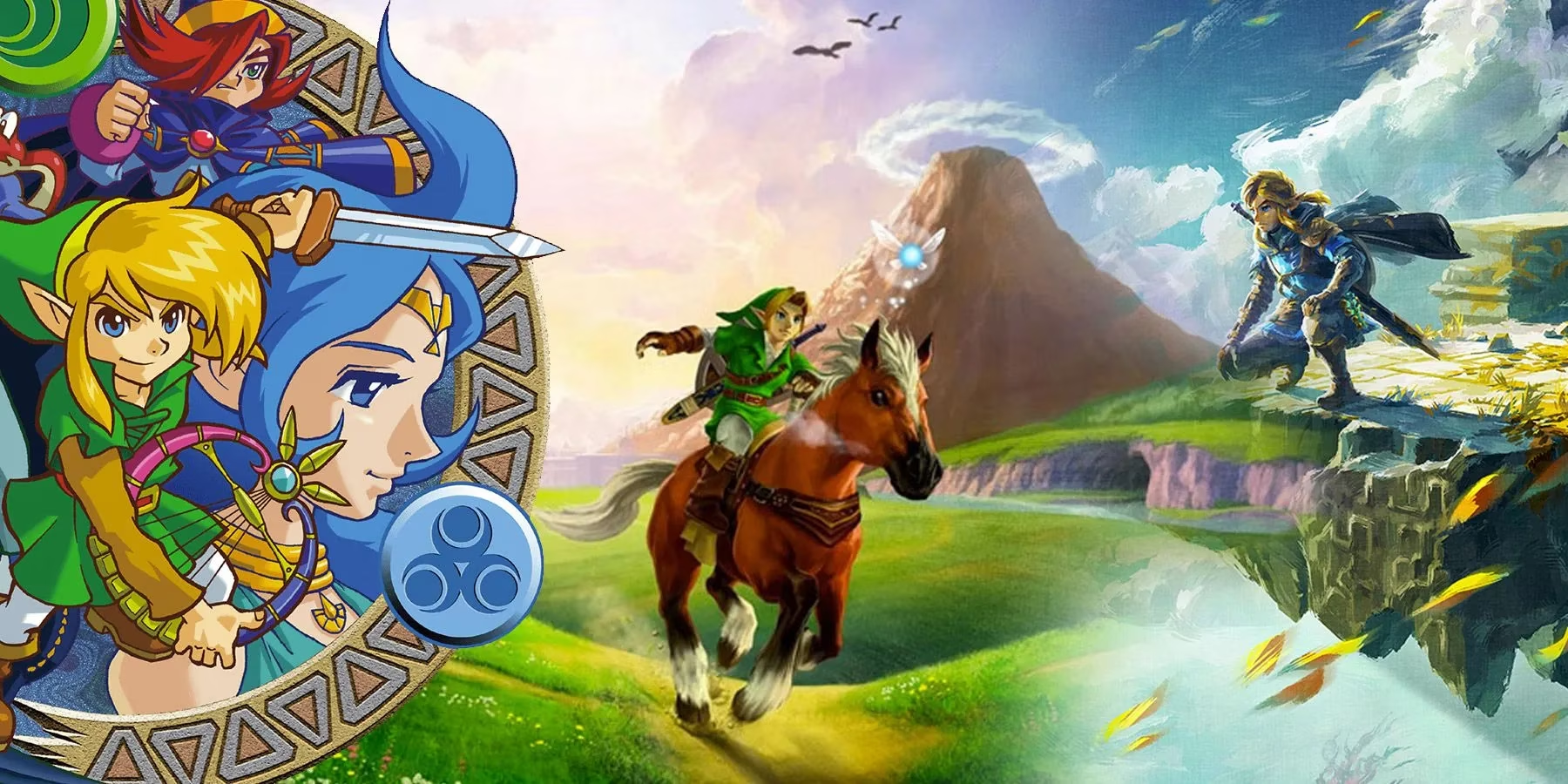
Ah, the Temple of Time. I remember the hushed reverence of that place, the way the light filtered through the stained glass as I placed the final Spiritual Stone. Pulling the Master Sword was supposed to be a moment of triumph. Instead, it was a severance. One moment, I was a child facing a destiny too large; the next, I awoke, seven years stolen, my childhood a ghost in the Sacred Realm. The Pedestal of Time became my anchor point between two shattered selves. As an adult, I saw a world corrupted by my failure. As a child, I carried the grim knowledge of a future yet to unfold. This wasn't just time travel; it was existential whiplash. The gameplay gimmick of switching eras to solve puzzles—using my childhood agility to access areas my adult strength could not—mirrored the narrative's core: the loss of innocence for the sake of duty. It set a bar, sky-high, that said time manipulation could be the soul of a game, not just a fancy trick.
Majora's Mask: The Three-Day Symphony of Despair
If Ocarina taught me the weight of years, Majora's Mask taught me the precious, terrifying value of 72 hours. Termina was a masterpiece of anxiety, with that baleful moon hanging low, a constant memento mori in the sky. The Song of Time was my reset button, my salvation, and my curse. I lived those three days on repeat, building a mosaic of lives:
-
🎭 Learning the schedules, fears, and hopes of every citizen.
-
⏳ Racing against a clock that refused to be cheated, only reset.
-
💔 Making bonds I knew would be wiped clean with a few notes on my ocarina.
This was time travel as groundhog day from hell, where progress wasn't measured in dungeons cleared, but in the small eternities of kindness I could cram into a doomed timeline. The central focus wasn't on changing a single past, but on perfecting a fleeting present, over and over, until I could stitch together a miracle. Talk about pressure cooker gameplay!
Oracle of Ages & The Portable Paradox
My journey through Labrynna in Oracle of Ages was a different beast—a more intimate, puzzle-box approach to chronology. The Harp of Ages was my key, opening rips in the world that let me step 400 years into the past. I'd see a withered, dead tree in the present, strum the harp, and suddenly be standing in the shade of its sapling ancestor. The entire world was a layered diorama. The genius was in the environmental storytelling: a crumbling ruin in my time was a bustling town in the past; a dry riverbed became a flowing waterway I could manipulate. Unlocking the Tune of Ages later felt like finally being given the master key to history itself. It remains, in my heart, one of the most cleverly designed Zelda experiences, a true hidden gem where time was the ultimate dungeon.
Twilight Princess & Skyward Sword: Fleeting Glimpses
These entries used time more as a poignant spice than the main course. In Twilight Princess, stumbling into the ancient Temple of Time was like finding a fossilized memory of Ocarina's glory. It was a self-contained, beautiful echo—a brief, nostalgic dungeon that acknowledged the past before firmly returning me to my own era. No grand alterations, just a respectful tip of the hat.
Skyward Sword, however, played with localized time. Hitting a Timeshift Stone was pure magic. In the Lanayru Desert, I'd watch as rusted, ancient machinery whirred to life in a golden haze, or a sea of sand receded to reveal a lush, watery past. It was time travel in a bottle, affecting small pockets of reality. The Gates of Time added a more linear, narrative-driven element, letting characters like Ghirahim and Zelda dance across eras. It was inventive, though it lacked the world-altering permanence of Ages or the personal stakes of Ocarina.
Tears of the Kingdom: The Ultimate Sacrifice Across Millennia
And then came 2023's masterpiece, Tears of the Kingdom. Here, time travel reached its most epic and tragic scale. Zelda didn't just travel through time; she was cast adrift in it, sent 10,000 years into Hyrule's founding age. Her story, revealed in murals and memories, broke me. Meeting the ancient sages, witnessing the first kingdom's birth, and then making the choice... to swallow her secret stone and become the Light Dragon. She sacrificed her very self, her mind and memory, to become an immortal guardian, holding the reforged Master Sword for eons just so it would be there for me, in my time.
Finding her, soaring high above the clouds, that blade gleaming in her forehead… It wasn't a puzzle to solve. It was a debt to repay. Her journey was one of passive, eternal vigilance, while mine in the present was an active scramble to mend a broken world. The two timelines—past and present—converged in that single, sublime moment when I pulled the sword from her brow. It was time travel as the ultimate act of love and faith, spanning millennia. Mind-blowing doesn't even begin to cover it.
A Timeless Legacy
| Game | Time Travel Mechanic | Emotional Core |
|---|---|---|
| Ocarina of Time | Pedestal of Time (Child/Adult) | Loss of Innocence, Destiny |
| Majora's Mask | Song of Time (72-hr Reset) | Anxiety, Compassion, Perfecting Moments |
| Oracle of Ages | Harp/Tune of Ages (400-yr Shift) | Environmental Puzzle-Solving, Cause & Effect |
| Twilight Princess | Temple of Time Portal | Nostalgic Echo, Contained Dungeon |
| Skyward Sword | Timeshift Stones, Gates of Time | Localized Restoration, Narrative Linear Travel |
| Tears of the Kingdom | Sealing Power / Dragonification | Sacrifice, Love Across Millennia, Convergence |
As I look back from the vantage point of 2026, the tapestry is clear. For me, Link, time travel in Zelda has never been about mere convenience or a cool power. It's been the narrative engine for exploring our deepest themes: the burden of memory, the cost of heroism, the fragility of the present, and the lengths we go to for those we love. Each iteration asks: What would you sacrifice for tomorrow? Would you lose your childhood? Relive your worst three days forever? Or would you lose yourself entirely across the ages to ensure a future you'll never see? That's the real magic. It’s why, after all these years and all these timelines, the legend endures. It’s not just about saving the world. It’s about understanding our place within the endless, beautiful river of time.