
The Future of Armor in Zelda: Building on BOTW and TOTK's Legacy
The future of Zelda armor systems stands at a thrilling crossroads, poised for a revolutionary evolution beyond the modular foundations of *Breath of the Wild* and *Tears of the Kingdom*. Imagine a profoundly granular system with specialized slots for gloves and footwear, unlocking unprecedented customization and strategic depth for the next legendary adventure.
As I look back from the vantage point of 2026, it's still hard to believe that The Legend of Zelda: Tears of the Kingdom released just last year. The wait for the next chapter in this legendary series feels immense, yet it's brimming with a unique kind of excitement. Nintendo has signaled a shift, a deliberate move away from the Breath of the Wild gameplay philosophy that has so brilliantly defined the modern era of Hyrule. The world of Zelda stands at a crossroads of opportunity, poised for another fundamental reset in its style of gameplay, its approach to storytelling, and perhaps even its very visual identity. The freedom pioneered by Breath of the Wild and then masterfully expanded upon by Tears of the Kingdom with mechanics like Ultrahand has set a monumental standard. Imagining where the series could possibly go next is a thrilling challenge for any fan.
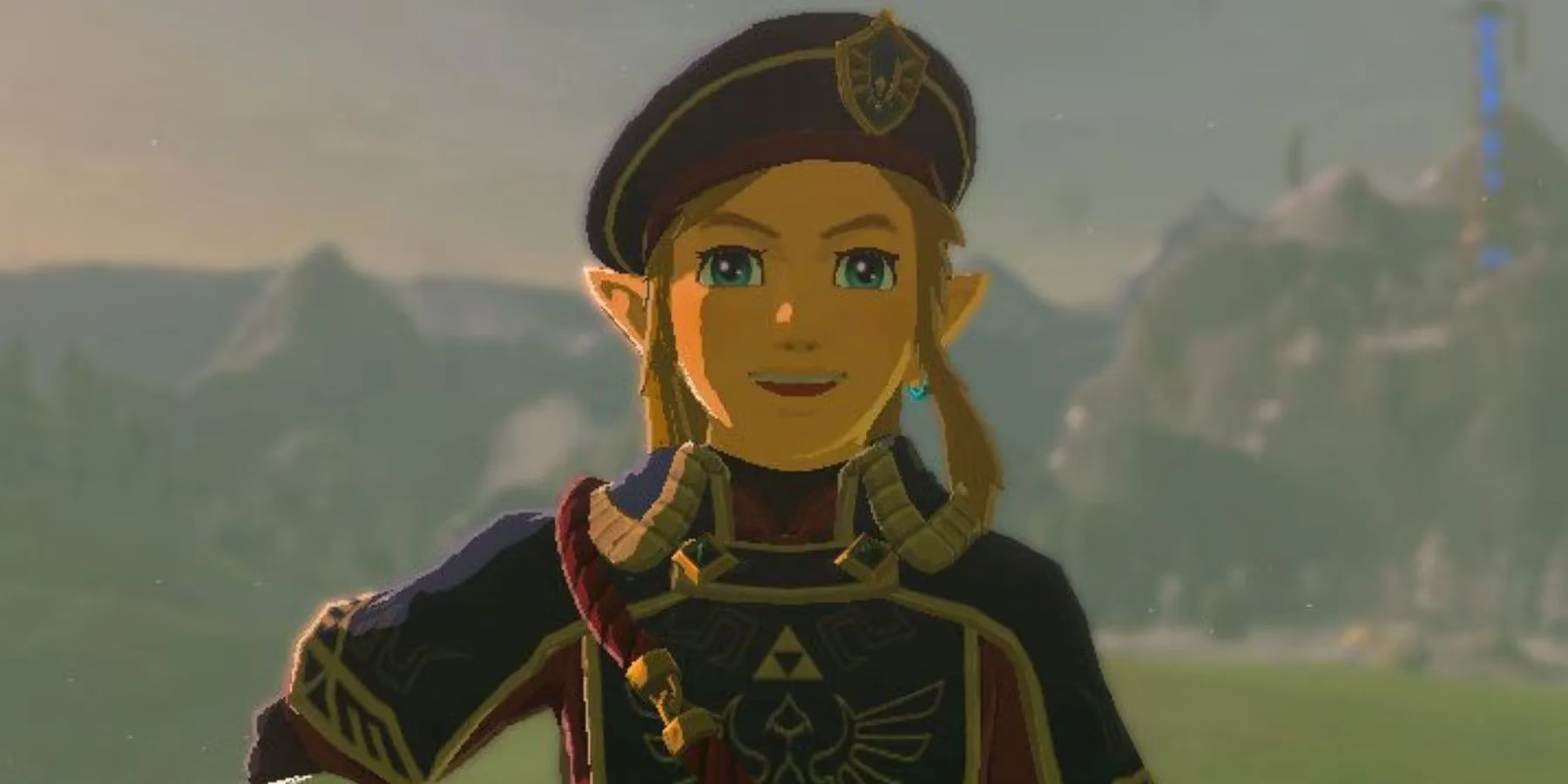
A Legacy of Change: From Static Outfits to Modular Gear
To understand the future, we must first appreciate the recent past. Before the era of Breath of the Wild, armor in Zelda was a much simpler affair. 😊 Link might acquire a special tunic for swimming or a magical set for specific dungeons, but these were complete, unchangeable costumes. The concept was static: you wore the Zora Tunic, or you didn't. There was no mixing, no matching, and certainly no worrying about individual defense ratings for your head, chest, and legs. Breath of the Wild shattered that tradition, borrowing a page from traditional action RPGs and introducing a brilliantly modular system.
This wasn't just a cosmetic change; it was a fundamental redesign of Link's relationship with his gear. Suddenly, we were strategists, carefully curating our loadouts based on the challenges ahead. Need to scale a freezing peak? The Snowquill set was our salvation. Planning to sneak into a Bokoblin camp? The stealth set became our second skin. This system was more than just stats; it was a layer of deep, personal customization that made every player's Link feel uniquely their own.
Tears of the Kingdom didn't reinvent this wheel; it made it roll smoother and shine brighter. It introduced fantastic new sets, deepened the upgrade paths, and integrated armor more seamlessly into the game's sprawling systems of exploration and creation. Yet, even with these improvements, it feels like we've only scratched the surface. The potential for growth is enormous.
The Next Evolution: A More Granular System
So, what could the next Zelda game, potentially a flagship title for the rumored Switch 2, do with armor? I believe the key lies in further modularity. The current system of Head, Body, and Legs is a great foundation, but it can be expanded.
Imagine a system with compartmentalized slots for:
-
Gloves/Gauntlets (affecting climbing speed, weapon handling, or special grabs)
-
Footwear/Boots (impacting running stamina, noise generated, or special movement like wall-jumping)
-
Facewear/Masks (offering environmental buffs, unique dialogue options, or perception abilities)
-
Cloaks/Capes (for style, gliding enhancements, or elemental resistance)
This wouldn't require a complete overhaul. It would be a natural, expansive evolution. Think of the combinatorial possibilities! You could wear climbing gloves with frost-resistant boots and a stealth mask, creating a hyper-specialized infiltration kit. This granularity would pair perfectly with the increased graphical fidelity and cinematic scope expected from a next-generation title. Customization would reach new heights, making our hero feel even more personally crafted.
Aligning Armor with a New Design Philosophy
The true impact of armor in the next game will be dictated by its core design philosophy. The last two titles placed exploration and emergent gameplay on a towering pedestal. What if the next chapter chooses to focus elsewhere?
Scenario 1: A Combat-Focused Hyrule 🗡️
If the series decides to hone in on refined, challenging combat, armor could take on a Souls-like dimension. We might see:
-
Weight and Poise Systems: Heavier armor slows movement and stamina regeneration but offers better defense and poise (resistance to being staggered).
-
Offensive Buffs: Armor pieces that enhance specific weapon types, critical hit chance, or charge attack speed.
-
Set Bonuses with Depth: Wearing a full ancient Sheikah set might not just give a defense boost, but could allow you to briefly phase through enemy attacks or charge ancient weapons faster.
Scenario 2: A Narrative or Puzzle-Driven Adventure 🧩
Conversely, the next game might de-emphasize combat in favor of story, social interaction, or complex environmental puzzles. Here, armor could become more cosmetic and situational.
-
Stat-Free Fashion: A vast wardrobe of purely aesthetic options, allowing for unparalleled role-playing and self-expression.
-
Contextual Utility: Armor that unlocks specific story paths, allows you to be disguised among certain enemy factions, or lets you interact with unique story-critical objects (e.g., a royal signet ring needed to access archives).
-
Puzzle Keys: Specific gear becomes essential for solving environmental puzzles, like magnetically-attuned gloves or boots that can walk on specific surfaces.
| Design Focus | Potential Armor Role | Example Mechanic |
|---|---|---|
| Combat & Challenge | Offensive/Defensive Loadout Core | Weight classes, weapon-specific buffs, parry windows |
| Exploration & Immersion | Environmental Survival Kit | More extreme temperature/weather effects, disease resistance |
| Narrative & Social | Cosmetic & Story Progression | Disguises, faction reputation, dialogue unlocks |
Building on a Strong Foundation
Regardless of the direction, one principle should remain sacred: build, don't scrap. The armor systems in Breath of the Wild and Tears of the Kingdom are not just good; they are foundational to the modern Zelda identity. They provide a perfect blend of strategy, customization, and tangible gameplay impact. The next game should use this as its bedrock.
Perhaps we'll see dye shops return with even more vibrant options, or an ability to visually transmogrify our gear—keeping the stats of our best-in-slot items but adopting the appearance of our favorite classic tunic. Maybe armor upgrading could involve more than just materials; it could involve completing specific quests tied to the armor's lore, deepening the world-building.
As I dream of stepping into a new Hyrule, I don't just see new landscapes. I see a Link whose attire tells a story—a story of choices made, challenges overcome, and a personal journey reflected in every piece of equipped gear. The future of Zelda's armor is not about discarding the past, but about weaving its strongest threads into an even richer, more personalized tapestry for the adventures to come. The legacy of Breath of the Wild and Tears of the Kingdom is a gift, and the next chapter has the thrilling task of opening it further.