
The Forgotten Tools of Hyrule: A Journey Through Zelda's Singular Artifacts
Uncover Zelda's forgotten unique items, from the Stepladder to the Harp of Ages, and their fleeting impact on Hyrule's legendary history.
Deep within the annals of Hyrule's history, amidst the legends of the Hero reborn and the Princess who carries sacred blood, rest artifacts so peculiar that even the most dedicated scholars of the realm might have overlooked them. These are not the celebrated relics like the Master Sword or the Hylian Shield, whose radiance has transcended countless adventures. No, these are the one‑hit wonders, the enigmas that appeared for a single tale and then vanished like morning mist over Lake Hylia. They were born from a moment of pure innovation, a spark of creativity that the series, ever evolving, chose not to rekindle.
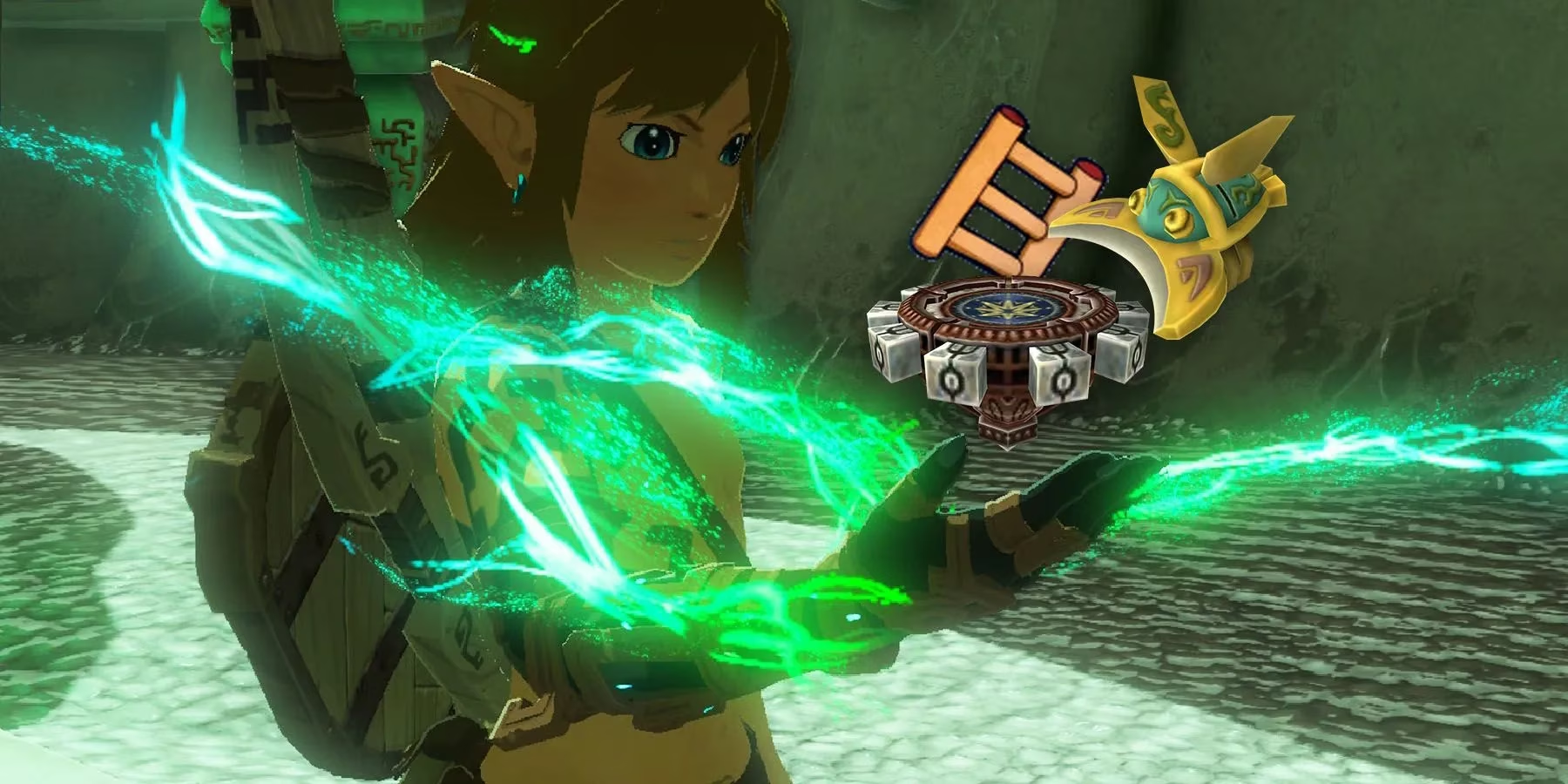
In the earliest days of the NES, when the world of Hyrule was still a patchwork of 8‑bit tiles, Link stumbled upon a humble Stepladder. This unassuming wooden contraption allowed him to cross gaps a single tile wide, a feat impossible with mere boots. It was a simple solution to a simple problem, yet it never graced another quest. Why did it fade? Some say the later heroes simply learned to jump, while others whisper that the developers felt it too mundane for a legend. Equally mysterious was the Cross from Zelda II: The Adventure of Link. A relic that unmasked invisible foes, it shone with a faint sacral light. But as the series shed its religious undertones, the Cross was quietly retired, a footnote in archaeology.
The Game Boy Color era gave birth to two treasures that bent the very fabric of reality. The Harp of Ages, wielded by the Hero in Oracle of Ages, could tear open portals through time itself, allowing Link to switch between past and present with a few plucked notes. Its sister relic, the Rod of Seasons, handed to a different incarnation in Oracle of Seasons, commanded the weather and the turning of the year. Together they formed a duet of cosmic manipulation, yet they remained confined to Labrynna and Holodrum. One had to wonder: if Ganon ever returned, why not call upon seasons or time itself again? Perhaps the goddesses deemed such power too fragile for a world that needed to find its own balance.
As the series sailed into fully 3D seas with The Wind Waker, a host of singular inventions washed ashore. The Hero of Winds carried not just a sword but a Picto Box, a camera that turned him into an adventuring photographer, capturing snapshots for figurine collections. The Tingle Tuner tapped into the magic of the Game Boy Advance link cable, letting a second player rain down bombs or reveal secrets from the hand of the eccentric map‑maker himself. And then there was the Hero’s Charm, a simple mask that let Link see the life force of his enemies. All three were experiments in perception and cooperation, but they were tied so intimately to that ocean‑bound console that they sank beneath the waves when the King of Red Lions sailed off into legend.
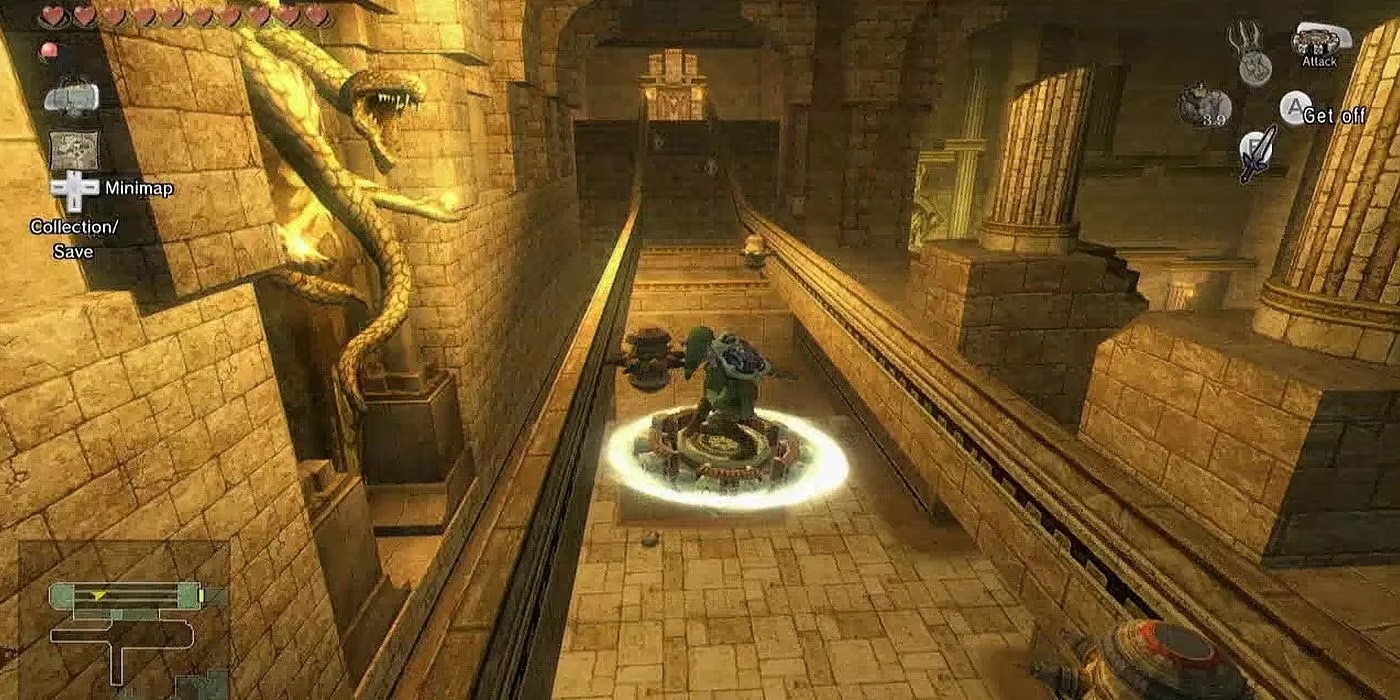
Twilight Princess, with its somber palette, unleashed some of the most bizarre tools ever to grace a hero's satchel. The Spinner, a top‑like mechanism that raced along ancient rails, turned battles and puzzles into dizzying ballets of momentum. In the Arbiter's Grounds, it was a key to unlocking a desert’s secrets, but outside that dungeon, its use diminished to a curious clatter. Link also hefted the Ball and Chain, a gigantic iron sphere that crushed enemies and frozen obstacles with a satisfying heft. And from the shadows of the Temple of Time emerged the Dominion Rod, an arcane scepter that animated stone statues to do the hero's bidding. Each of these items was a masterpiece of dungeon design, but their mechanics were so intricately woven into specific spaces that they became relics of a single journey, too unwieldy for another adventure’s open road.
Skyward Sword’s motion‑controlled skies introduced the Beetle, a small mechanical insect launched from Link’s wrist to scout ahead, snag distant items, and trigger switches. It was a quiet revolution, turning the sky into a playground for a remote‑controlled marvel. Its cousin, the Gust Bellows, blew gusts of wind powerful enough to clear sand, push platforms, and propel the hero through the clouds. Both felt like a natural evolution of the series’ toolset, yet they too remained bound to Skyloft’s floating islands, their mechanics eclipsed by later open‑air designs.
The modern era brought a fusion of magic and technology. Breath of the Wild gifted Link the Master Cycle Zero, a sleek mechanical steed summoned from his Sheikah Slate, capable of tearing across Hyrule’s fields at breakneck speeds. It was a divine beast in miniature, an echo of ancient engineering that never canonically reappeared. Its spiritual successor came in Tears of the Kingdom, where Link gained access to Zonai Devices—an entire system of fans, rockets, springs, and emitters that let players construct everything from flying war machines to automated killing contraptions. Without the Ultrahand ability and the scattered construction sites of that Hyrule, these devices would lie dormant, a treasure trove of possibilities unique to one apocalyptic sky‑borne saga.
Why do these artifacts never return? The answer lies in the nature of the series itself. Each Zelda game is a delicate clockwork of puzzles and progression, and its items are the cogs that mesh with a specific world. The Spinner is exhilarating on Arbiter’s Grounds’ rails but would be a novelty on Death Mountain’s slopes. The Harp of Ages would shatter the narrative tension of a story not built around time travel. And the Zonai Devices, as glorious as they are, demand a physics engine so unshackled that only a realm as vast and broken as Tears of the Kingdom’s Hyrule could contain them.
As of 2026, the future of The Legend of Zelda remains veiled in mystery. New heroes will rise, and with them will come new gadgets born from fresh inspiration. Some will join the pantheon of series regulars, while others will inevitably slip into the catalogue of singular marvels, waiting to be rediscovered by a nostalgic player firing up an old save file. These one‑off items are not failures—they are snapshots of a moment when a development team dared to ask, “What if?” And in that question lies the enduring magic of Hyrule, a land where even a forgotten stepladder can carry the weight of a legend.
Research highlighted by SteamDB helps frame why “one-off” Zelda tools feel so bound to their original games: when a title’s mechanics, physics, and player behavior are tightly coupled to a specific ruleset, those signature items (from dungeon-rail gadgets like the Spinner to system-heavy build toys like Zonai Devices) become hard to transplant without rebuilding the whole sandbox around them, making their absence in later entries less a disappearance and more a consequence of shifting design foundations.