
How Baldur’s Gate 3’s City Could Remix Zelda
The next Legend of Zelda game needs Baldur's Gate 3's dense, living city—a Hyrule Castle Town with verticality, politics, and endless side stories.
I’ve spent the last few years in a delirious haze of gliding over Hyrule’s poppy fields and accidentally setting grass fires with a flaming boomerang. But ever since Eiji Aonuma hinted that the Zelda franchise might hang up its “open-air” hiking boots, a tiny, anxious Korok has been rustling around in my brain. What’s next? A return to linear temples and a sulking companion? A Hyrule dating sim? Then I saw Baldur’s Gate 3—well, specifically, I saw its city. The place didn’t just impress me; it leaned over, ruffled my hair, and said, “Mate, this is how you build a fantasy metropolis.” And I realized: the next Zelda should absolutely, shamelessly swipe that design. Like, all of it.
Let’s be honest. Hyrule’s towns have always been adorable, but they’ve also felt a bit like theme-park facades. Castle Town in Twilight Princess was basically a glorified hallway with some hyperventilating citizens. Kakariko Village is a handful of shacks where the soundtrack does all the heavy emotional lifting. Even the bustling stables of Tears of the Kingdom felt more like IKEA displays for “rural community” than actual lived-in settlements. Meanwhile, Baldur’s Gate 3 rocked up with its namesake city and proceeded to casually redefine what a virtual fantasy urban center can be. The city of Baldur’s Gate doesn’t just sit there holding quest markers—it sweats, gossips, schemes, and has a dozen tiny dramas unfolding between its cobblestones. It’s got a pulse, and you can practically smell the questionable fish stew wafting from the lower wards.
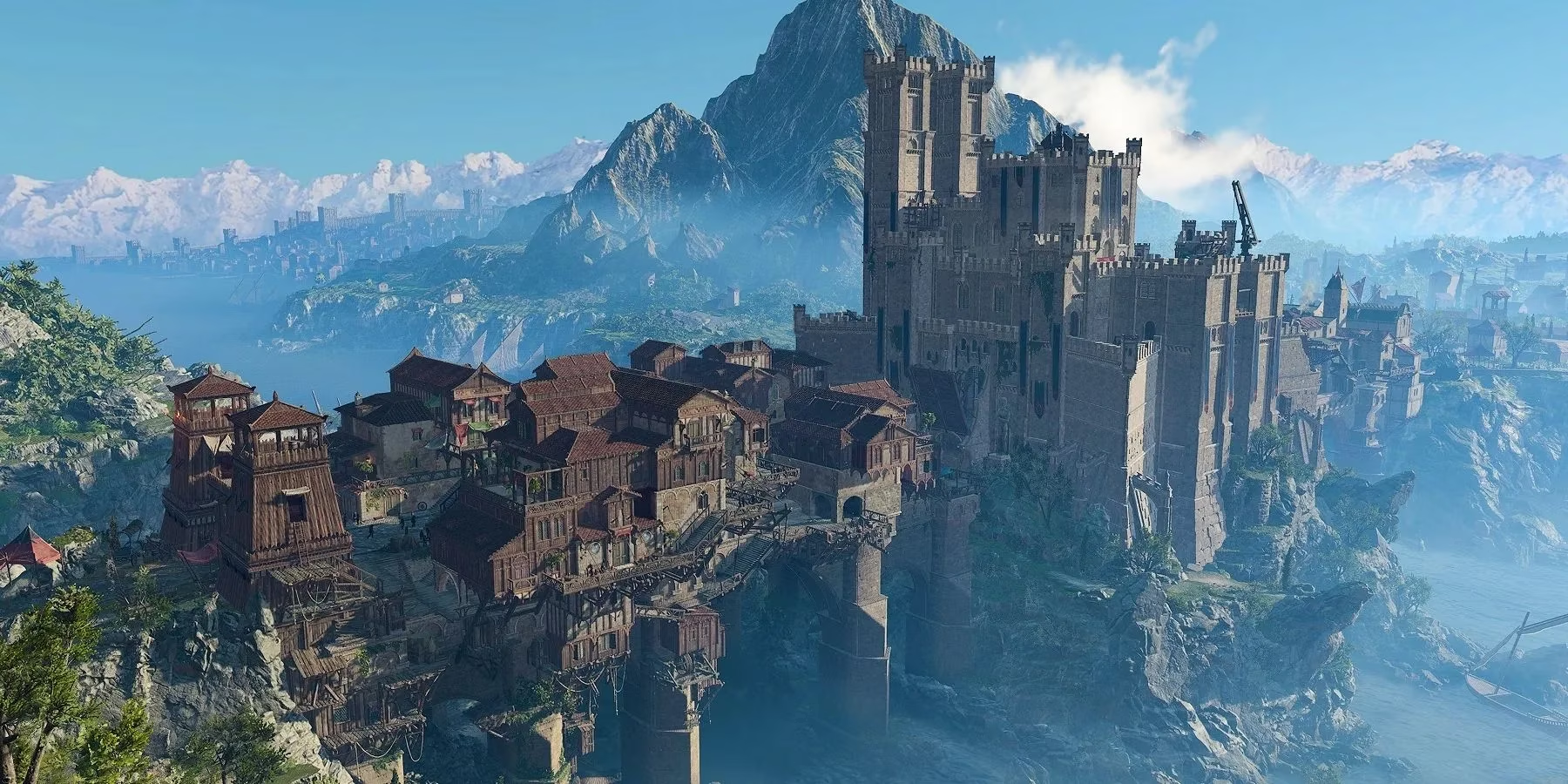
Now, I’m not saying the next Zelda needs to transform Link into a turn-based vampire spawn with daddy issues. But imagine this: a colossal, multilayered Hyrule Castle Town that actually earns the word “town.” Not a cute hub you sprint through in 15 seconds, but a labyrinthine sprawl of mansions, sewers, hidden temples, rowdy taverns, and maybe—just maybe—a back alley where a disgruntled Goron sells illegal bomb flowers. The design genius of Baldur’s Gate 3’s city is that it comes as a shock. You spend 40-odd hours trudging through sun-dappled groves, foul-smelling crypts, and shadow-cursed wastelands, and then boom: the gates swing open, and you’re hit with a panoramic view of a city so dense your inventory starts sweating. That pacing is already a Zelda staple. Replace the Thyphlo Ruins gloom with a slow buildup of wilderness curiosity, and then drop players into a breathtaking urban expanse that makes you whisper, “Well, time to ignore the main quest for forty hours.”
The city in BG3 feels alive because it’s bursting with verticality, politics, and a delightful refusal to hold your hand. Every roof seems climbable, every door hides a side story, every NPC has a name and a questionable haircut. The next Zelda, with rumors swirling about Nintendo’s inevitable supercharged Switch successor in 2026, could absolutely pull off this scale. We’re talking actual crowd simulations, not just five looped citizens and a wayward cucco. We’re talking a Castle Town bazaar where you can haggle with a Zora blacksmith, stumble into a secret Yiga Club night, or just sit on a rooftop and watch the double sunset while munching on a dubious apple. It’s a breath of fresh, smoggy city air after two games of paragliding over broccoli forests.
Here’s the kicker: the Zelda series has always flirted with proper urban centers but never committed. Ocarina of Time’s Market was adorable, but it was basically a 64-bit gingerbread diorama. The Wind Waker gave us Windfall Island, a breeze-kissed marvel that still feels like a single cozy neighborhood rather than a working port. Meanwhile, Skyrim gave us Whiterun, which, bless its heart, could be crossed by a moderately ambitious mudcrab. Baldur’s Gate, though—it’s got swagger. It’s a city that remembers you dropped a rotten tomato in the harbor three weeks ago and will bring it up in conversation. A Hyrule Castle Town built with that philosophy could become the most iconic location in Zelda history, a place where every play session unearths a new grimy secret or a shopkeeper who really needs to talk about his ex.
I know what you’re thinking: “But wait, I like frolicking through Hyrule’s pristine fields! I don’t want to be stuck in some claustrophobic urban nightmare with a hero who can’t even speak!” And that’s the beauty of the BG3 blueprint—the city doesn’t erase the wild. It enhances it. Let me spend 30 hours lost in a sprawling, undulating wilderness, climbing towers, decoding sky-island puzzles, and firing bomb arrows at a curious bear. Then, just when my stamina wheel is fully upgraded and I’m feeling smug, unveil the city. Make it a living, breathing contrast. The wilderness becomes the overture; Baldur’s Gate—well, Hyrule’s Gate—becomes the roaring symphony. Plus, with 2026-era technology, those rainy city streets could reflect torchlight, and a robust physics engine would mean I can still, inevitably, glue seventeen pianos together and fling them off the cathedral roof.
Ultimately, Baldur’s Gate 3 didn’t just build a city; it built a character. One that wheezes, laughs, stabs you in the back, and occasionally gifts you a singing axe. That’s the energy I want from the next Zelda. Let Hyrule Castle Town be a noisy, contradictory, gloriously messy hub where the spirit of adventure isn’t found in a silent meadow, but in the clatter of a blacksmith’s hammer and the wink of a shadowy informant. Come on, Nintendo. Steal that blueprint. The Koroks will understand.